




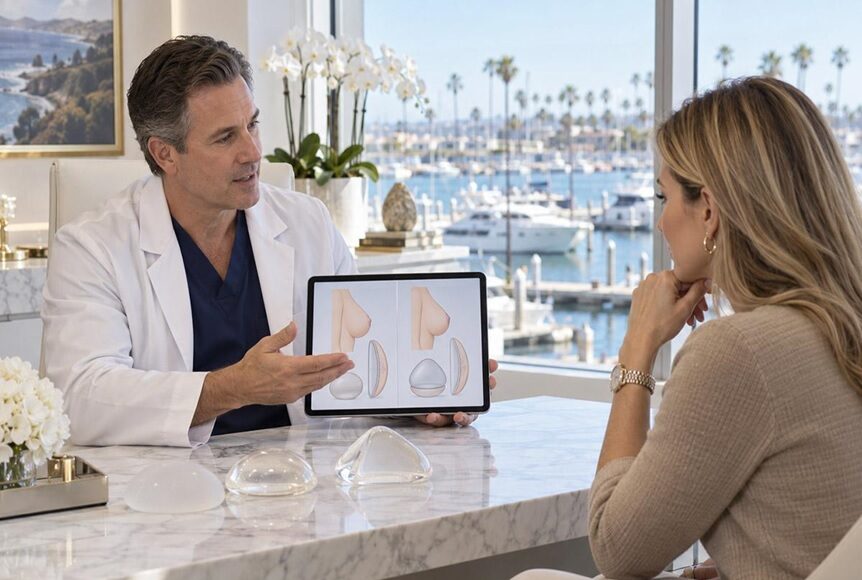
Silicone vs. Gummy Bear Implants: Which Feels More Natural?

Gummy bear implants are silicone implants. The difference is cohesivity, meaning how tightly the gel holds together. Firmer, form-stable gel keeps its shape and resists rippling, while softer gel compresses more easily. Feel depends heavily on your own tissue coverage and implant placement. Shape, rupture behavior, FDA imaging schedules, and personal anatomy all belong in the consultation conversation.
Most patients researching silicone vs. gummy bear implants arrive with the same worry: they want to look like themselves, not like they had surgery. They have read that one option feels softer and another holds its shape better, and somewhere in the comparison the two terms started sounding like competing products from different companies. They are not.
At The One Plastic Surgery Center in Newport Beach, board-certified plastic surgeon Dr. Siamak Agha spends much of the breast augmentation consultation untangling this exact confusion. Every gummy bear implant is a silicone gel implant. What separates them from the softer gels is a property called cohesivity, and it affects far more than how the implant feels between your fingers. It changes shape retention, rippling, rupture behavior, and even how the device is inserted. Here is what actually differs and what that means for the result you see in the mirror.
Silicone vs. Gummy Bear Implants: What the Terms Describe
Silicone gel implants have a silicone shell that is filled with silicone gel. “Gummy bear” is an informal nickname for highly cohesive, form-stable versions of the same device. The gel is cross-linked more tightly, so it behaves like a soft solid instead of a thick liquid.
The FDA recognizes two fill categories for breast implants: saline-filled and silicone gel-filled, each available in different sizes with smooth or textured shells. There is no separate regulatory category called “gummy bear.” That word describes a position on a spectrum, not a brand.
The practical test surgeons use is simple. Cut a form-stable implant in half, and the gel stays put, holding the cut edge. Do the same with a lower-cohesivity gel, and it slowly slumps. That single property drives most of the differences discussed below.
The Cohesivity Spectrum: Firmness Is a Range
Cohesiveness is not a yes or no setting. Manufacturers produce gels across a gradient, from soft and highly compressible to firm and shape-holding, and most product lines offer several options.
Firmer gel resists folding and wrinkling under the skin. A prospective comparison of soft cohesive versus lower cohesivity gel implants published in the Journal of Plastic, Reconstructive and Aesthetic Surgery found wrinkling or rippling in 9.2 percent of breasts in the more cohesive group compared with 55 percent in the lower cohesivity group. Patients rated the firmer devices as slightly stiffer, yet overall satisfaction was significantly higher in that group.
That trade-off sits at the center of the decision. A softer gel may feel more yielding to the touch. A firmer gel is less likely to show a visible ripple along the upper pole or the side of the breast, particularly in someone with thin tissue.
“Cohesivity is a spectrum, not a product. Every gel sits somewhere between soft and shape-holding.”
Which Feels More Natural? Coverage Matters More Than Gel
Feel is determined by what sits on top of the implant as much as by what is inside it. A firmer implant under generous breast tissue and muscle can feel softer than a very soft implant placed under thin skin with little native tissue to cushion it.
This is why two people can receive the same device and describe entirely different sensations. Your starting breast volume, skin thickness, chest wall shape, and whether the implant sits above or below the pectoral muscle all change the answer.
Interestingly, the same cohesivity study found that minimum tissue coverage thickness did not correlate as strongly with visible problems as many assumed, which suggests gel behavior and tissue quality work together rather than one simply overriding the other. The honest conclusion is that no implant category universally feels more natural. The right question is which implant suits your tissue.
Placement options on the practice’s breast augmentation page, including submuscular and subglandular positioning, are part of the same conversation. So is implant width relative to your chest measurements, which often constrains the choice more than patients expect.
Shape, Rotation, and Why Round Implants Remain Common
Most form-stable implants marketed as gummy bear devices are shaped, meaning fuller at the bottom than the top, to echo a sloped breast profile. Round implants distribute gel evenly, so they look the same no matter how they sit. Shaped implants only look correct in one orientation, which introduces rotation as a consideration.
How often does that matter? A study using high-resolution ultrasound to evaluate 138 shaped gel implants found that 27 percent of implants and 42 percent of patients had rotation of more than 30 degrees, far higher than previously believed. Independent reviewers looking at patient photographs could identify only a small fraction of those rotations, and the authors concluded that the rotations did not translate into clinically significant problems.
That finding cuts both ways. Rotation is more common than the marketing suggests and also less visually consequential than patients fear. Round smooth silicone remains widely used partly because it removes the question entirely and partly because a softer round device can settle into a natural slope on its own.
Rupture, Silent Rupture, and FDA Screening
Silicone gel implants can rupture at any point after surgery, and the FDA notes that most silicone ruptures are silent, meaning there are no symptoms and no change you can see or feel. That is the central reason imaging surveillance exists.
Form-stable gel behaves differently when a shell fails. Because the gel holds together, it tends to stay within the implant capsule rather than migrating, which is one of the arguments made for highly cohesive devices. It does not make rupture impossible, and it does not remove the need for monitoring.
FDA labeling guidance recommends that for people with silicone gel implants, “the first ultrasound or magnetic resonance imaging (MRI) should be performed at 5-6 years postoperatively, then every 2-3 years thereafter.” MRI is recommended when symptoms appear or when ultrasound results are unclear.
Adherence is a significant concern. An ASPS-reported study found that only a small minority of patients obtained screening imaging on the recommended schedule, with cost coverage and simple lack of awareness cited as barriers. The FDA is equally clear that breast implants are not lifetime devices and that additional surgery should be anticipated over the years.
“Silent rupture has no symptoms, which is exactly why the imaging schedule exists.”
Surface Texture and the BIA-ALCL Question
Shell surface is a separate variable from gel firmness, though the two often get bundled together because many shaped implants use textured surfaces to help them stay oriented.
The FDA has determined that the risk of breast implant-associated anaplastic large cell lymphoma, a lymphoma of the immune system rather than a breast cancer, is higher with textured surface implants than with smooth ones. Fill type, silicone or saline, does not appear to change that risk. Warning signs include persistent swelling, a lump, or pain near an implant, often years after surgery.
For people who already have textured implants and have no symptoms, the FDA does not recommend routine removal. For anyone choosing implants now, the surface question deserves a direct conversation. The practice’s page on breast implant complications covers this alongside capsular contracture, rippling, and revision options.
Age Rules, Systemic Symptoms, and the Consultation
The FDA approves silicone gel implants for breast augmentation in women age 22 or older and saline implants for augmentation at age 18 or older. Both are approved for breast reconstruction at any age. Those thresholds are regulatory, not negotiable by preference.
Reported systemic symptoms, often grouped under the term “breast implant illness,” also belong in this conversation. A systematic review and meta-analysis of 36 studies covering more than 10,000 patients found joint complaints, fatigue, muscle pain, and cognitive difficulty among the most commonly reported symptoms and noted that a consistent symptom-based definition is still needed. The FDA acknowledges these reports while describing them as poorly understood.
None of that means implants are unsafe or that symptoms are imagined. It means the discussion should be specific rather than reassuring by default. The practice’s dedicated page on breast implant illness explains how symptoms and explant options are evaluated, and secondary breast augmentation covers revision planning for patients already living with implants.
Key Takeaways
- Gummy bear implants are silicone implants; the distinction is gel cohesivity, not a different material or brand.
- Firmer gel reduces visible rippling, while softer gel compresses more easily, and satisfaction data does not favor one universally.
- How an implant feels depends heavily on your tissue coverage and placement, not gel firmness alone.
- The FDA recommends first ultrasound or MRI screening at five to six years after silicone implant surgery, then every two to three years.
- Textured surfaces carry a higher BIA-ALCL risk than smooth surfaces, and we discuss systemic symptom reports individually at consultation.
Results and candidacy vary from patient to patient. This article is educational and is not medical advice. An in-person consultation is required to determine which implant type, size, and placement are appropriate for you.
Making the Choice With Real Information
There is no universally softer implant and no universally safer one. Highly cohesive gel offers shape retention and less rippling. Softer gel offers more give under the hand. Your tissue thickness, chest dimensions, goals, and tolerance for future maintenance decide which trade-off makes sense, and a thorough consultation should let you hold both and feel the difference yourself.
Ready to find out which implant type suits your anatomy and your goals? Schedule a consultation with board-certified plastic surgeon Dr. Siamak Agha at The One Plastic Surgery Center in Newport Beach to review implant options, placement, imaging follow-up, and the risks that matter for you.
Frequently Asked Questions
Are gummy bear implants and silicone implants the same thing?
They are both silicone gel implants. “Gummy bear” is an informal term for highly cohesive, form-stable gel that holds its shape when cut. The FDA recognizes only saline-filled and silicone gel-filled categories, so cohesivity describes a position on a spectrum rather than a separate device type.
Which implant type feels the most natural?
There is no single answer, because feel depends on your breast tissue, skin thickness, and whether the implant sits above or below the chest muscle. Softer gel compresses more readily, while firmer gel resists rippling. Many patients compare both during a consultation before deciding.
How often do I need imaging after getting silicone implants?
FDA labeling guidance recommends a first ultrasound or MRI at five to six years after surgery, then every two to three years afterward, because most silicone ruptures cause no symptoms. MRI is recommended if you develop symptoms or if an ultrasound result is unclear.
Do shaped implants really rotate?
Ultrasound research has found rotation more often than surgeons once believed, with one study detecting rotation in about a quarter of the shaped implants studied. In that same study, independent reviewers rarely detected those rotations in photographs, suggesting most are not visually significant.
Are textured implants still used, and what about BIA-ALCL?
The FDA has found that BIA-ALCL risk is higher with textured surfaces than with smooth ones, and that fill type does not change the risk. For people with textured implants and no symptoms, the FDA does not recommend routine removal. Surface choice should be discussed directly before surgery.