


How Modern Laser Eye Surgery Is Changing the Future of Vision Correction

Clear vision affects many parts of daily life, from reading and driving to working on screens, exercising, and recognising faces from a distance. For people who depend on glasses or contact lenses, the idea of reducing that dependence can be appealing. This is one reason why laser eye surgery has become an important topic in modern eye care.
Laser eye surgery is designed to correct common vision problems such as short-sightedness, long-sightedness, and astigmatism. These conditions occur when light does not focus properly on the retina, which is the light-sensitive layer at the back of the eye. Instead of using glasses or contact lenses to adjust the focus from outside the eye, laser procedures reshape the cornea so that light can focus more accurately.
For many patients, the decision to consider treatment begins with a simple question: can my vision be corrected safely and effectively? The answer depends on several factors, including eye health, prescription stability, corneal thickness, age, lifestyle, and expectations. Anyone considering laser eye surgery should first undergo a detailed consultation with an experienced eye specialist.
Why Laser Eye Surgery Has Become More Advanced
Laser eye surgery has developed significantly over the years. Earlier forms of vision correction were effective for many patients, but modern technology has allowed doctors to assess the eye in greater detail and plan treatment with more precision.
Today, diagnostic scans can measure the shape, thickness, and surface quality of the cornea. These measurements help eye specialists decide whether a person is suitable for treatment and which procedure may be most appropriate. A careful assessment is important because two people with the same glasses prescription may have very different eye structures.
Modern laser platforms are also designed to deliver treatment with a high degree of accuracy. The purpose is to reshape the cornea in a controlled way while preserving as much healthy tissue as possible. This is one reason why proper screening before surgery is so important. Suitability should never be assumed based only on prescription power.
Common Vision Problems Treated with Laser Procedures
Laser eye surgery is commonly used for short-sightedness, also called myopia. People with myopia can usually see near objects clearly but struggle with distant objects, such as road signs, classroom boards, or faces across a room.
It may also be used for long-sightedness, known as hyperopia. This can make near tasks difficult, and in some cases, distance vision may also be affected. Astigmatism is another common condition, where the cornea has an uneven curve, causing blurred or distorted vision at different distances.
The suitability of laser treatment depends not only on the type of prescription but also on its stability. If the prescription is still changing, the doctor may advise waiting until it becomes stable.
The Role of Patient Selection
One of the most important developments in modern laser eye surgery is the emphasis on careful patient selection. A good outcome begins before the actual procedure. The specialist must confirm that the eyes are healthy and that the treatment is appropriate.
During a consultation, the patient may undergo scans, vision tests, tear film assessment, corneal mapping, and a review of medical history. The doctor may ask about dry eye symptoms, previous eye infections, contact lens use, medications, and general health conditions.
Some patients may not be suitable for laser eye surgery. For example, those with certain corneal conditions, unstable prescriptions, severe dry eye, or inadequate corneal thickness may be advised against it. In such cases, other options may be discussed.
This careful approach protects patients and helps set realistic expectations.
What Patients Usually Want to Know
Most people considering laser eye surgery have practical concerns. They want to know whether the procedure is painful, how long recovery takes, whether both eyes can be treated, and when they can return to work.
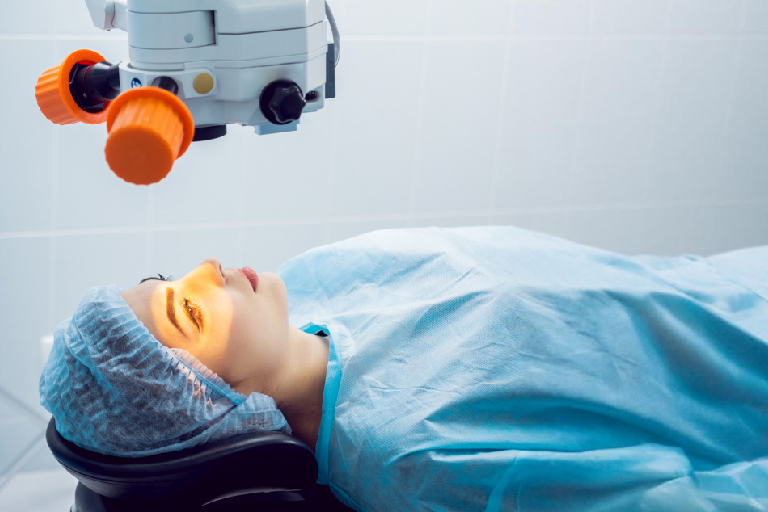
The procedure itself is usually quick, although the full appointment may take longer because of preparation and post-treatment checks. Anaesthetic eye drops are commonly used to reduce discomfort. Patients may feel pressure or mild irritation, but the experience varies depending on the procedure and the individual.
Recovery also depends on the type of laser treatment performed. Some people notice clearer vision quite soon, while others may experience temporary fluctuations. Dryness, glare, halos, or light sensitivity may occur during recovery. The eye specialist will explain what is expected and what symptoms should be reported.
Why Aftercare Matters
The success of laser eye surgery does not depend only on the procedure. Aftercare is also essential. Patients are usually given eye drops and instructions to protect the eyes while healing. They may be advised to avoid rubbing the eyes, swimming, eye makeup, dusty environments, or intense activity for a specific period.
Follow-up visits allow the doctor to check healing and vision improvement. These visits should not be skipped, even if the patient feels well. Some issues can be detected early during routine review.
Good aftercare also includes following instructions exactly. Using drops irregularly or returning too quickly to activities that strain or expose the eyes may affect comfort and recovery.
A More Personalised Future for Vision Correction
Modern eye care is moving toward more personalised treatment planning. Instead of offering the same approach to every patient, specialists can use detailed measurements to recommend treatment based on the individual eye.
This is particularly important because vision is closely linked to lifestyle. A person who drives at night, works long hours on a computer, plays sports, or has a visually demanding profession may have different needs from someone with a less demanding routine.
The best treatment plan should consider the patient’s eyes, habits, expectations, and long-term comfort.
Conclusion
Laser eye surgery has changed the way many people think about vision correction. It offers selected patients the possibility of reducing dependence on glasses or contact lenses, but it must be approached with proper evaluation and realistic expectations.
Modern technology has improved assessment, planning, and treatment accuracy. However, the most important step remains a detailed consultation with a qualified eye specialist. Patients should understand their suitability, the benefits, the risks, the recovery process, and the aftercare requirements before making a decision.
For those who are suitable, laser eye surgery can be a meaningful option in the journey toward clearer everyday vision.